Last updated: May 2026. Verify before booking.
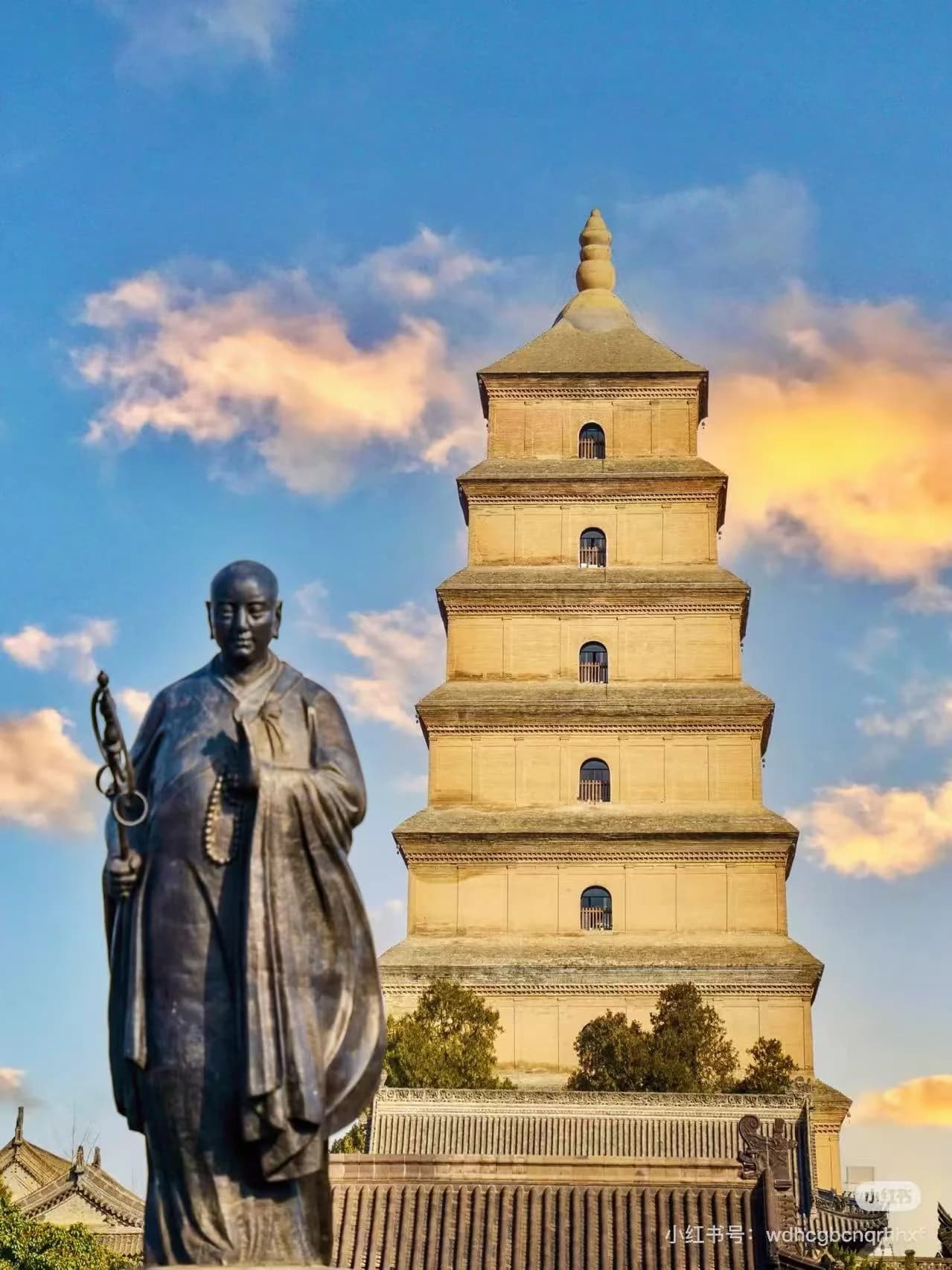
Evening light filters through the gingko trees in Da Ci'en Temple Park, and suddenly there it is: a seven-story square pagoda, 64 meters of brick stacked in graduated tiers. Each level sits slightly smaller than the one below, creating a silhouette that reads more solid than elegant. This isn't a tower built for climbing — the interior staircase is narrow and steep, and only a handful of visitors make it to the top. Its value lies in the moment you stand at its base looking up, and later when darkness falls, when the music starts and the fountains launch, water jets rising against the lit pagoda.
What Makes It Worth Your Time
The pagoda's significance isn't architectural; it's narrative. In 652 AD, Xuanzang — the historical monk who inspired the Journey to the West character — returned to Chang'an after 17 years in India. He carried 657 volumes of Sanskrit Buddhist texts, and the emperor funded this pagoda to house them. Over the next 19 years, Xuanzang translated 75 works totaling 1,335 volumes here, including the earliest Chinese version of the Heart Sutra. When you stand at the base, you're standing at one of the most concentrated sites of knowledge production in Chinese Buddhist history. This isn't a museum piece; it's a still-functioning religious site, though tourists now outnumber monks. Understanding this background gives weight to what otherwise looks like a plain brick tower.
What to Realistically Expect
First, the climb: you can buy tickets to enter the pagoda, but the interior wooden staircase is steep and narrow, with only small windows for ventilation on each level. If enclosed spaces or climbing tight stairs aren't comfortable for you, this won't be a pleasant experience. Second, the crowds: during daylight hours, the pagoda is a tour group magnet, and the plaza noise persists until sunset. The real experience begins in early evening — after the tour buses depart, locals arrive with children, and the musical fountain starts at 8 PM. Summer fountain shows draw large audiences; if you want a good position to see the full pagoda framed against the water, arriving at the north plaza 30 minutes early is necessary. Physical demands are low: flat ground walking only, no climbing required to appreciate the site.
Don't Miss
The gingko grove in Da Ci'en Temple Park The park south of the pagoda is free to enter, planted with dozens of century-old gingko trees. If you visit from late October to early November, golden leaves carpet the ground while the pagoda rises behind them. This is the most underrated angle for photographing the pagoda — no crowds, just trees, brick, and shifting light.
The side angle of the musical fountain Most visitors crowd the front railing of the north plaza. Walk to the east or west sides — far fewer people, and you can see the full pagoda framed against the fountain rather than just water and the tops of strangers' heads. The fountain show starts at 8 PM and runs about 20 minutes.
The Indian architectural traces on the pagoda's exterior Look closely at the arched doors and decorative moldings — these details derive from Indian Buddhist stupa traditions, not traditional Chinese pagoda styles. Xuanzang brought back more than texts; he brought architectural knowledge.
Practical Information
Da Ci'en Temple Park is free to enter; pagoda admission is ¥25 (approximately $3.50 USD), with half-price tickets for students. Opening hours are 8:00 AM–5:30 PM during peak season (March 16–November 15) and 8:00 AM–5:00 PM during low season (November 16–March 15), open year-round. Plan for 1.5–2 hours including park walking and fountain viewing. No advance booking required; purchase tickets on-site. The nearest metro station is Dayanta on Line 3 or Line 4, Exits C or B, both leading directly to the north plaza with a three-minute walk. The musical fountain show starts at 8:00 PM nightly, lasting approximately 20 minutes, free to watch. Official website: [TODO - verify official site]. What to buy nearby: The Shaanxi specialty shops east of the pagoda's south plaza vary in quality; the underground mall at the north plaza offers more consistent cultural products, or walk ten minutes to the Joy City mall for better-designed souvenirs.
Getting There
The most convenient route is Metro Line 3 or 4 to Dayanta Station, Exit C, which leads directly to the north plaza. If walking from the city center, head south from the Bell Tower along South Street, pass through the city wall, and continue along Chang'an Road — the pagoda appears on your right, impossible to miss. The most common mistake is visiting during peak tour group hours — between 4 PM and 6 PM the plaza is packed, tour buses occupy all parking, and guide megaphones create constant noise. Arrive after 6 PM instead: walk the southern park first, then claim a spot at the north plaza before the 8 PM fountain show.
When you leave the Big Wild Goose Pagoda, you'll carry an incomplete picture: you know Xuanzang worked here for nearly 20 years, but you can't truly imagine what those 20 years were like. The pagoda won't tell you the whole story — it's only the beginning.
Related Guides:
- Xi'an City Guide — Complete city guide


