Last updated: April 2026
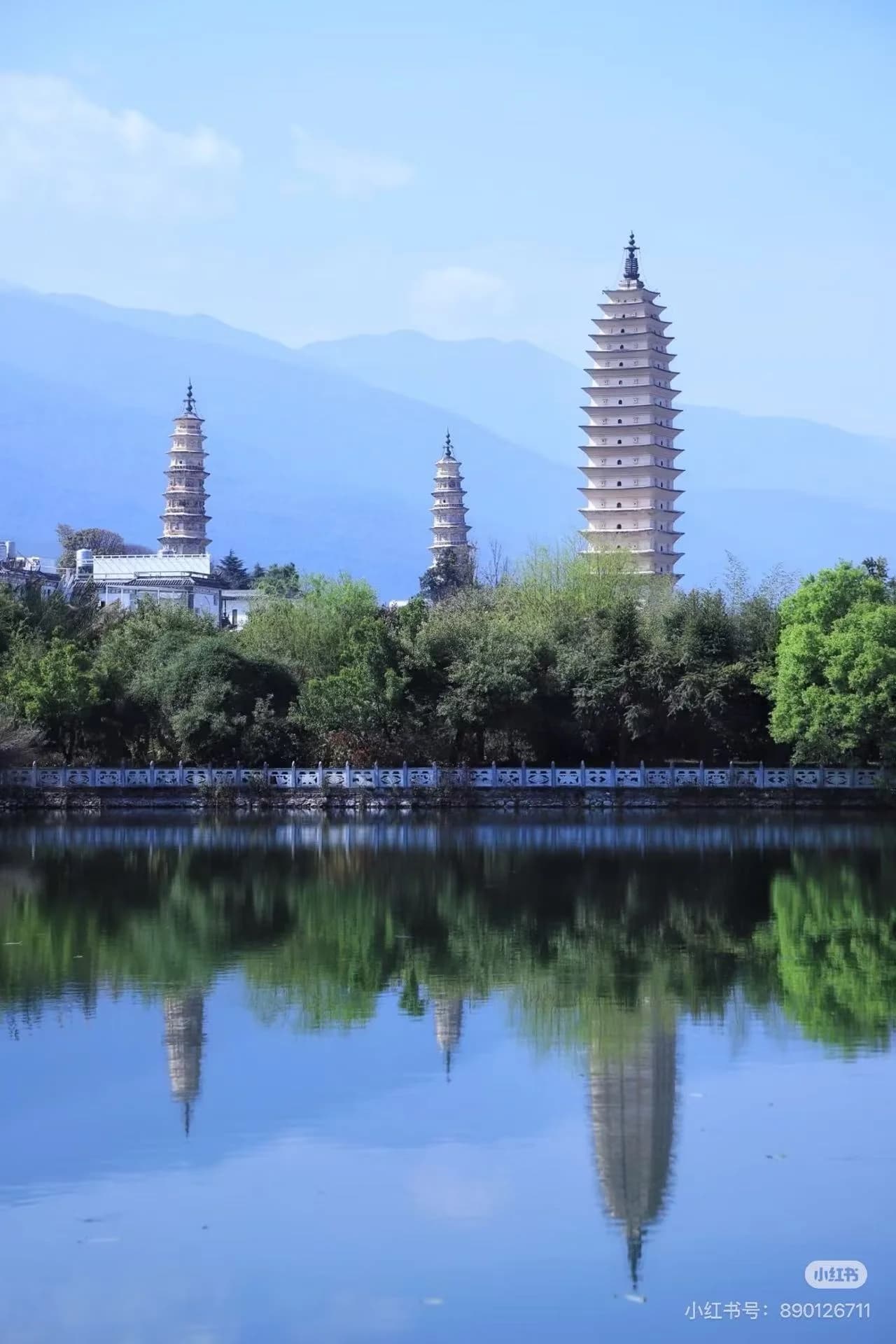
Three white pagodas stand at the base of Cangshan Mountain: the main tower reaches 70 meters high, while two smaller towers stand 42 meters each. They form an equilateral triangle, with a reflection pool in front that creates the illusion of six towers on clear days — three real, three reflected in water. This is Dali's most photographed composition. But the real story is what these towers represent: the only surviving large-scale structures from two kingdoms that ruled this region for over 500 years.
From 738 to 1253, two independent kingdoms controlled this territory — the Nanzhao Kingdom (南诏) and the Dali Kingdom (大理). These were not Chinese provincial outposts but sovereign states with their own armies, writing systems, diplomacy, and Buddhist traditions. Nanzhao even fought military campaigns against the Tang Dynasty. Both kingdoms are now gone. Their palaces vanished. Their city walls crumbled. Their writing systems died. Yet these three pagodas remain standing in their original locations.
The main pagoda, called Qianxun Tower (千寻塔), was built between 823 and 840 during the Nanzhao period. The two smaller pagodas were added roughly 100 years later under Dali Kingdom rule. The towers were constructed to guard the feng shui between Cangshan Mountain and Erhai Lake — one mountain, one lake, three towers positioned to stabilize the dragon line and protect the kingdom's prosperity. Chongsheng Temple, which once stood behind the pagodas, served as the royal monastery. Nine Dali Kingdom emperors chose to renounce their thrones and become monks here — a testament to Buddhism's extraordinary influence in a state that rivaled the Chinese imperial centers in wealth and power.
What Makes it Worth It
At 121 yuan (61 yuan for students, free for those over 70), the ticket is not inexpensive by Dali standards. A bowl of erfu noodles costs 8 yuan; a guesthouse room, 100 yuan. But the price covers three pagodas and an entire reconstructed temple complex. You can spend 2-3 hours here without hurrying.
The core reason to visit: these are the only surviving above-ground structures from 500+ years of kingdom rule. Palaces are gone. City walls erased. Administrative records lost. Only three towers remain, standing where they were placed 1,200 years ago.
The main tower is hollow inside, 16 stories tall, with walls that taper from 3.3 meters thick at the base to much thinner toward the top. Over 1,200 years and 30+ earthquakes, the structure has never collapsed. In 1978, renovations revealed over 700 Buddhist artifacts inside the tower — gold and silver Buddha statues, crystal vessels, bronze mirrors. These are not replicas. They were excavated from inside the structure and now sit in the on-site museum. They are direct physical evidence of two disappeared kingdoms.
For Western visitors, consider this analogy: imagine a European empire that once controlled half a continent for 500 years. All its palaces and castles have vanished. Only the bell towers of three churches still stand. That approximates what these pagodas represent to Dali.
The temple complex itself was rebuilt in 2005 and covers 8+ acres (21,000 square meters). The rebuilt sections have limited historical value on their own, but walking through them provides spatial context for understanding Nanzhao and Dali Kingdom Buddhist culture. The museum inside is essential — over 700 original artifacts from 1978 excavations are displayed there.
What to Expect
From the entrance, head first to the pagoda area. This is the core. Walk around the towers and examine the brick carvings and Buddha images in detail. The reflection pool sits directly in front of the three pagodas — this is the spot for the classic "six towers" photograph.
Best time for photography: 7:30-9:00 a.m. Light is soft, water is still (fewer visitors, no wind), and visibility is sharp. Early mornings after rain are especially good. Midday produces backlighting problems. Afternoon brings crowds.
After viewing the pagodas, continue upslope past the reconstructed Chongsheng Temple. Follow the central axis up multiple staircases, passing large halls, until you reach Wanghai Tower — a high platform with views back toward the pagodas and across to Erhai Lake. This section takes 30-40 minutes with significant stair climbing.
The museum (located within the grounds) displays 1978 excavations. If you have interest in Nanzhao or Dali Kingdom history, this deserves time.
Normal exploration of the entire grounds takes 2-3 hours. If you only want to photograph the pagodas and skip the temple, 1 hour suffices — but most of the 121-yuan ticket goes to waste.
Don't Miss
- Come early to the reflection pool — Get there before 9 a.m. when it's quiet and the water's calm. After 9 a.m. the wind kicks up and you lose the reflection.
- The museum — Most people just take photos of the pagodas and leave. The museum is easy to miss, but 700 original artifacts from the tower excavation explain why these structures matter.
- Wanghai Tower — Walk to the temple's highest point and look back at the pagodas with Erhai Lake behind them. It's a different view from the reflection pool.
Practical Information
| Item | Details |
|---|---|
| Admission | 121 yuan (students 61 yuan, over 70 free) |
| Hours | May 7-Oct 7: 7:10–19:00 / Oct 8-Apr 30: 7:30–18:30 |
| Last entry | 17:30 |
| Time needed | 2-3 hours (pagodas only: 1 hour) |
Prices are indicative — confirm before booking.
Getting There
From Dali Ancient City, walk northwest approximately 20-30 minutes.
From Old Town, take a tourist shuttle bus — about 10 minutes.
Public bus Route 19 reaches the site.
Taxi from Old Town costs approximately 10-15 yuan.
Common Mistakes
- Going at the wrong time — Afternoon light is harsh and frontal (backlighting). Crowds peak in mid-to-late afternoon. Morning is non-negotiable for the reflection pool shot.
- Underestimating stair volume — The ascent from pagodas to temple height includes extensive stair climbing. Not accessible for people with mobility issues.
- Expecting interior access — The three towers are exterior only. You cannot enter them.
- Questioning the 121-yuan price — If you want only pagoda photos, you can shoot them from outside the grounds at a distance for free. If you commit 2-3 hours to the pagodas, museum, and rebuilt temple complex, the price is reasonable.
Before You Go Checklist
- [ ] Plan to arrive between 7:30-8:00 a.m.
- [ ] Bring water — the grounds are large and full exploration requires 2-3 hours
- [ ] Wear comfortable shoes — extensive stair climbing
- [ ] Fully charge phone/camera — the reflection pool is the primary photo location
Twelve centuries ago, Nanzhao built three towers between a mountain and a lake to protect the landscape's vital force. The kingdoms dissolved. Palaces crumbled. But the towers still stand. When you stand before the reflection pool and see six white towers — three real, three reflected in water — you're looking at the only thing left from a world that lasted 500 years and then completely disappeared.