Last updated April 2026. Verify before booking.
The Great Compassion Hall is octagonal, two stories tall, appearing from distance like a small pagoda among traditional buildings. Inside, the vaulted ceiling curves toward the center, sunlight streaming through side windows, incense smoke rising. Step outside and your view splits: rooftops of Xiamen University and coastline in one direction; five peaks of Wulaofeng lined as a natural barrier in the other. Front facing sea, back against mountains — rare for Chinese temples.
What Makes it Worth It
China has thousands of temples, but Nanputuo pairs several uncommon elements together.
The spatial layout — Most Han Buddhist temples hide in mountains or squeeze into city blocks. Nanputuo faces sea directly (Lotus Lake, then coastline) with Wulaofeng rising behind. Along the central axis: water at sea level on one side, mountain ridgeline on the other. This front-sea-back-mountain arrangement is nearly impossible to find elsewhere in Chinese coastal cities.
The Great Compassion Hall — Built 1928, this octagonal structure houses Guanyin statues, including a rare 48-armed figure. Octagonal halls are uncommon in Han Buddhist architecture; most use square designs. The eight-sided shape makes it stand out, appearing like a small tower embedded among rectangular buildings.
A scholarly center — Nanputuo opened the Minnan Buddhist Academy in 1925, where two major teachers worked: Hung-i (born Li Shutong, pre-monastic musician and calligrapher who became a major modern Buddhist figure) and Master Yinshun. Both left manuscripts and teachings still studied today. For those interested in Buddhist intellectual history, this scholarship distinguishes Nanputuo from ordinary temples.
The name means "South of Putuo" — Putuo Mountain in Zhejiang is one of China's four major Buddhist centers. Nanputuo mirrors that role, dedicated to Guanyin, and serves as the highest-ranking Guanyin center in southern Fujian.
What to Expect
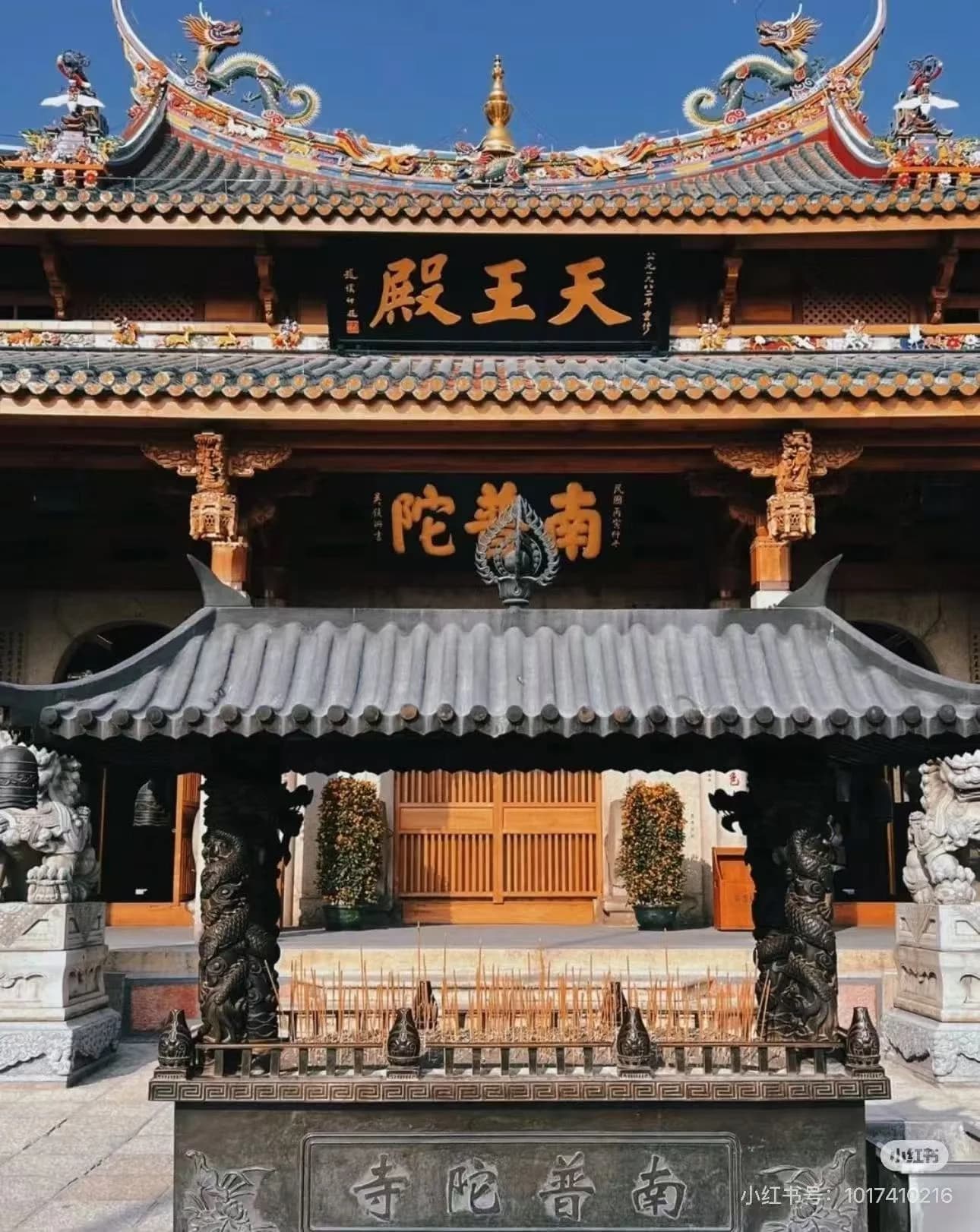
The temple is compact. Walking the central axis takes 15-20 minutes: Heavenly Kings Hall (entrance) → Great Hall (1921, the largest) → Great Compassion Hall (octagonal, 48-armed Guanyin) → Scripture Hall (1936). Incense is free; no photography inside halls.
Lotus Lake in front blooms in summer — lotus, temple eaves, and Wulaofeng ridge create a three-layer shot worth the camera work.
Wulaofeng trail begins at the rear gate (30 yuan extra). Mostly stone steps, moderate difficulty, 45 minutes to summit. The view justifies the climb: Nanputuo's red walls and yellow tiles below, Xiamen University's campus, and the southern coastline visible at once. Regular hiking shoes work.
Vegetarian restaurant sits to one side — not standard canteen fare but actual vegetarian dishes. Slightly pricier than outside, but eating in the quiet temple courtyard carries a unique calm.
Don't Miss
- Combine with Xiamen University — The campus sits 100 meters away. One option: temple + Wulaofeng hike, vegetarian lunch, then walk the university grounds. Three destinations in half a day, 30 yuan total cost.
- Photograph the octagonal hall from the side — The red walls and octagonal eaves with Wulaofeng backdrop work better from side angles than head-on shots.
- Visit early morning — Crowds peak 10:00-12:00 and 14:00-16:00. Come by 8:00 for quiet access.
Practical Information
| Item | Details |
|---|---|
| Entry | Free (requires WeChat reservation) |
| Wulaofeng trail | 30 yuan |
| Hours | 08:00–20:00 |
| Time needed | Temple: 30 minutes; + trail: 1.5–2 hours; + university: half day |
| Address | 515 Siming Nan Rd, Siming District, Xiamen |
| Booking | WeChat mini-program reservation required; walk-ups may be turned away |
Payment: Alipay and WeChat Pay accepted. Cash works for incense donations.
Prices are indicative — confirm before booking.
Getting There
- Metro Line 3: Exit B from Nanputuo Station, 3-minute walk
- Metro Line 1: From Zhenhai Rd Station, 5-minute walk
- Bus: Routes 1, 21, 45 to Xiamen University stop
From campus: Walk along Siming Nan Rd; the temple entrance is 100 meters south.
Common Mistakes
- Forgetting the dress code — Shoulders and knees must be covered inside halls. Remove hats and sunglasses before entering.
- Photographing inside halls — Prohibited; outdoors only.
- Not reserving — WeChat reservation is mandatory; arriving without one risks denial of entry.
- Assuming the trail is included — The 30-yuan Wulaofeng climb is separate; the temple alone is free.
Before You Go Checklist
- [ ] Make WeChat reservation for the temple — do this before you arrive
- [ ] Wear long pants or knee-length skirts — dress code is enforced
- [ ] Pack hiking shoes if ascending Wulaofeng — the 45-minute stone-step climb is steep
- [ ] Bring water — the trail has no refreshment stops
- [ ] Plan the half-day combination — temple + trail + university gives you a complete outing
The temple itself takes 30 minutes, but if you add the Wulaofeng hike and a walk through Xiamen University, you've got a solid half-day outing. The unusual thing here is the spatial arrangement — sea on one side, mountains on the other. Most Chinese temples don't sit in that kind of position.