Last updated April 2026. Verify before booking.
Top floor of Linggu Pagoda, wind coming from every direction, shirt still damp from the climb. Two hundred and fifty-two spiral steps to get here, but the view makes you forget about your legs — to the west, the blue-glazed roof of Sun Yat-sen Mausoleum pokes through the tree canopy; further out, the square tower of Ming Xiaoling Tomb. Both places you walked through earlier this morning. To the north, Nanjing's skyline flattens out toward the Yangtze. You've spent about three hours connecting an emperor's tomb, a revolutionary's burial site, and a memorial tower for fallen soldiers — all on one mountain, all on foot. That doesn't happen from the shuttle bus.
What This Actually Is
Purple Mountain has three major sites packed into about 8 kilometers: the tomb of Zhu Yuanzhang, founding emperor of the Ming Dynasty (built 1381); the mausoleum of Sun Yat-sen, founder of the Republic of China (completed 1929); and the Memorial Pagoda for fallen soldiers of the Northern Expedition (built 1933). Three completely different eras sharing the same ridge, all within a 2-kilometer walk of each other.
Most visitors take the scenic shuttle between them — get off, take photos, get back on, next stop. The shaded plane-tree roads, the hillside stone steps, the trails where you'll only see Nanjing locals doing their morning exercises — all of that gets skipped.
This article is about walking instead of riding. Not a fitness challenge — a way of experiencing these three sites as connected chapters of the same story rather than three separate ticket gates.
Is It Worth It
If you're already planning to visit Sun Yat-sen Mausoleum and Ming Xiaoling Tomb, walking between them is a better half-day than visiting each separately and taking a shuttle in between. The extra cost is physical effort and about two hours.
Works well if you:
- Don't want to stand in line with tour groups at entrance gates — 90% of the walking route has nobody on it except local morning exercisers
- Want to understand why three very different historical figures all ended up on the same mountain
- Are visiting in mid-November when the ginkgo trees along the Sacred Way turn gold
Probably not ideal if you:
- Have knee problems — total stair count exceeds 2,000 steps across the route (Sun Yat-sen Mausoleum alone has 392)
- Have limited time and want to carefully read every inscription at Ming Xiaoling — this route prioritizes connection over deep exploration, with about 30-40 minutes at each stop
The Real Experience
Ming Xiaoling Tomb and the Sacred Way (8:00-8:50)
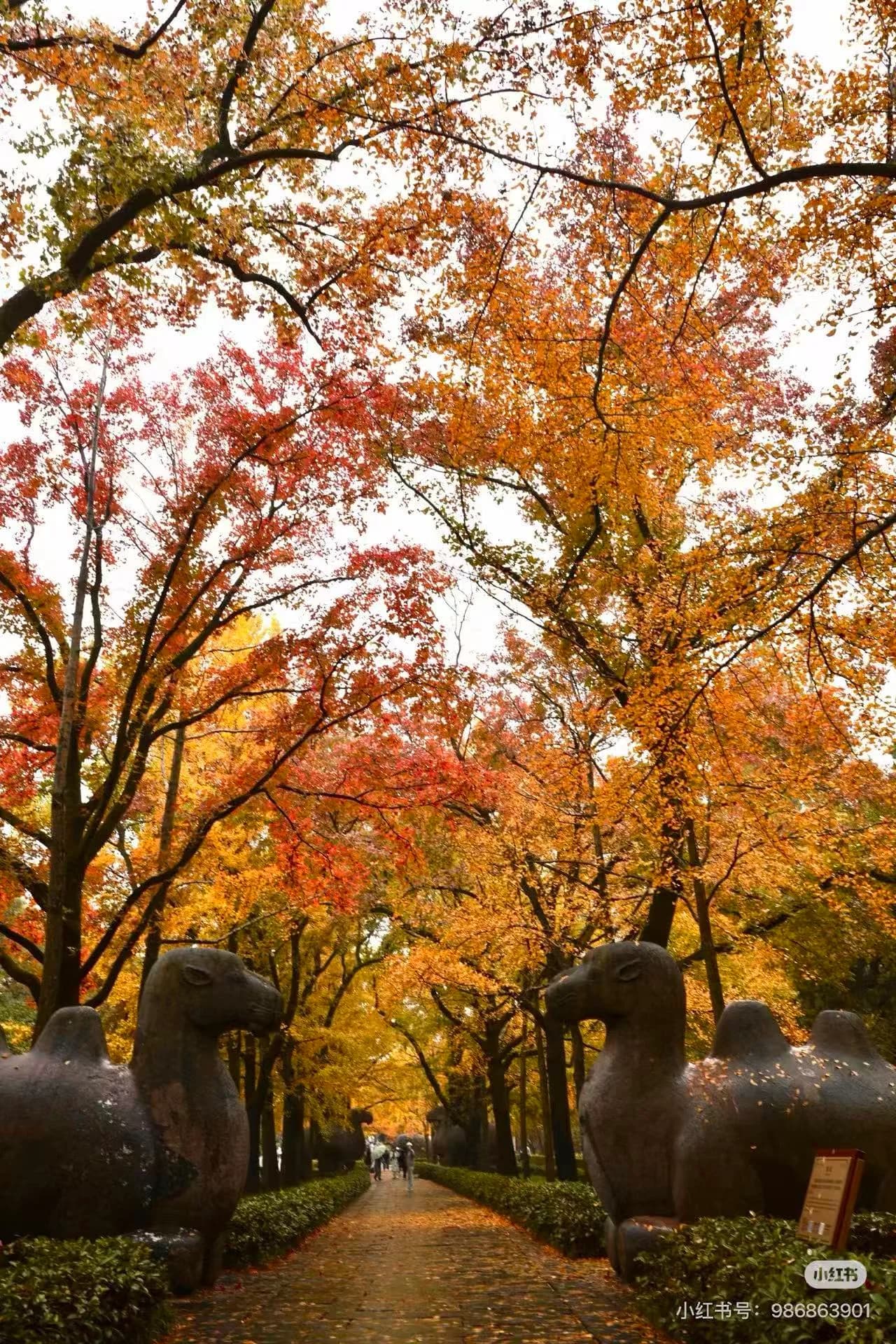
Start at the south gate of Ming Xiaoling Tomb and walk the Sacred Way first. This 615-meter stone path is lined with 12 pairs of carved stone animals — lions, camels, elephants, horses, qilin, and xiezhi — carved during the early Ming Dynasty, unmoved for over 600 years. At 8am the light is angled, casting long shadows on the stone figures, and the crowds haven't arrived yet.
If you come between mid-November and early December, the Sacred Way transforms. Ginkgo trees on both sides turn solid gold, fallen leaves blanket the ground, and gray stone animals stand inside a golden tunnel. Nanjing locals call it the most photogenic 600 meters in the city. Hard to argue with that once you see it.
Ming Xiaoling is the tomb of Zhu Yuanzhang, the emperor who founded the Ming Dynasty. The underground palace isn't open, but the above-ground scale gives you a sense of what matters: this is the template that later imperial tombs — including Beijing's Ming Tombs — were based on. Forty minutes is enough to see the main structures without rushing.
When you leave here, you're stepping out of 1381. The next stop is 1929.
Along the Ring Road to Sun Yat-sen Mausoleum (9:00-9:50)
Exit through Ming Xiaoling's east gate and walk 1.8 kilometers along the Ring Road to Sun Yat-sen Mausoleum. Flat, paved, shaded by plane trees — this is your warm-up. The road itself was built in the 1920s specifically for the construction of Sun Yat-sen's mausoleum. The funeral procession in 1929 came this way.
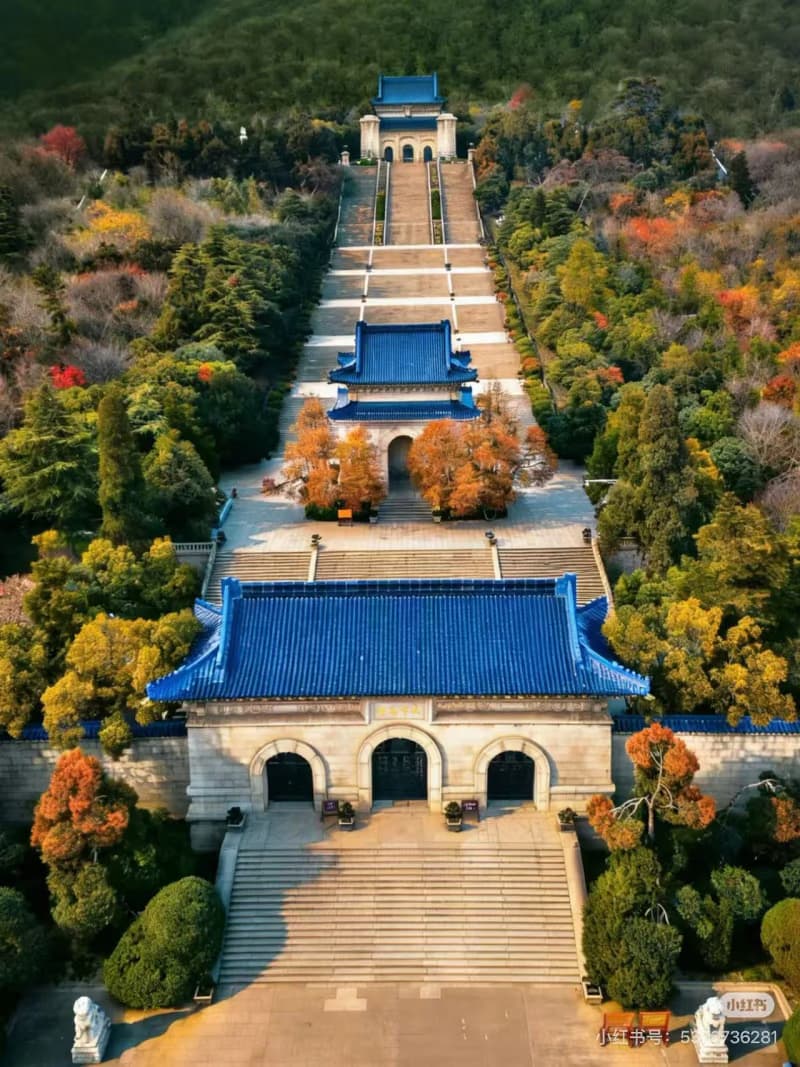
Sun Yat-sen Mausoleum is free but requires a WeChat reservation (same-day slots fill up fast — book 1-2 days ahead). The 392 steps from the entrance gate to the memorial hall have a design detail worth knowing: looking up from the bottom, you see only steps and no platforms; looking down from the top, you see only platforms and no steps. This isn't a tour guide invention — it was architect Lu Yanzhi's original intent.
At the top, turn around. Northern Nanjing stretches out below you. Inside the memorial hall is a seated statue of Sun Yat-sen. Photography is not allowed inside.
Two people who changed the course of Chinese history, buried less than 2 kilometers apart, on the same mountain. Walking between them makes this connection feel real in a way that shuttling doesn't.
Linggu Temple and Linggu Pagoda (10:00-10:50)
From the east exit of Sun Yat-sen Mausoleum, walk another 1.5 kilometers to the Linggu Temple area. The path starts to have some elevation changes, and the crowds thin out noticeably.
Two things worth stopping for here:
Beamless Hall — A Ming Dynasty structure built entirely from brick and stone, without a single wooden beam. Walk inside, look up at the vaulted ceiling, and notice the echo. This kind of construction is rare in Chinese architecture. Takes two or three minutes to look around — worth the stop.
Linggu Pagoda — Nine stories, 60 meters tall, designed in the 1930s by American architect Henry Murphy and Chinese architect Dong Dayou. Originally named the Memorial Pagoda for Fallen Soldiers, honoring those killed in the Northern Expedition. You can climb 252 spiral steps to the top floor for an unobstructed 360-degree view of Purple Mountain and Nanjing. Better sightlines than the top of Sun Yat-sen Mausoleum, and far fewer people.
This is the best viewpoint on the entire route.
Optional: Summit at Toutuo Peak (11:00-12:00)
If you still have energy, continue from Linggu Temple up the north trail to Purple Mountain's summit at Toutuo Peak (449 meters). About 1.3 kilometers, over 1,400 steps, steep — allow 40-60 minutes.
There's an observation platform at the top with a wider view than Linggu Pagoda, but the incremental improvement is modest. If Linggu Pagoda already satisfied you, this section is skippable.
Don't want to climb? There's a cable car: one-way 60 yuan, round-trip 100 yuan, about 10-15 minutes to the top.
How to Do It
Route: Ming Xiaoling south gate → Sacred Way → Ming Xiaoling main structures → Ring Road walk to Sun Yat-sen Mausoleum → 392 steps → Walk to Linggu Temple / Linggu Pagoda → (optional) north trail to Toutuo Peak → shuttle bus or walk back
Getting to the start: Metro Line 2 to Muxuyuan Station, then walk 15 minutes to Ming Xiaoling south gate.
Costs:
| Item | Price |
|---|---|
| Ming Xiaoling (combo ticket includes Linggu Temple) | 70 yuan |
| Sun Yat-sen Mausoleum | Free (WeChat reservation required) |
| Walking trails | Free |
| Cable car (one-way / round-trip) | 60 / 100 yuan |
| Scenic shuttle bus | 10 yuan per ride |
Prices are indicative — confirm before booking.
Time needed: About 3.5 hours without the summit climb, 4.5-5 hours with it.
Payment: Alipay and WeChat Pay accepted everywhere. Hilltop convenience shops may require cash — bring about 50 yuan in small bills. Credit cards not accepted.
Best time to go: Spring (April-May) is the most comfortable temperature. Mid-November is the best time of year — that's when the Sacred Way ginkgo trees turn gold. Summer is hot and humid; walking this route in July or August will be rough. Weekdays are quieter than weekends.
Common Mistakes
- Showing up at Sun Yat-sen Mausoleum without a reservation — There's no ticket window. Search for the Sun Yat-sen Mausoleum mini-program on WeChat and book a morning slot 1-2 days ahead.
- Buying a second ticket at Linggu Temple — The 70-yuan Ming Xiaoling ticket is a combo that includes Linggu Temple. Don't pay again at the gate.
- Walking the route in reverse — Going from Linggu Temple toward Ming Xiaoling means you hit the Sacred Way in the wrong light (morning sidelight looks best) and walk the steep sections first when you're fresh but the flat sections when you're tired. Start at Ming Xiaoling.
- Underestimating the stairs — Sun Yat-sen Mausoleum (392) plus Linggu Pagoda (252) plus elevation changes between sites adds up to over 2,000 steps. Wear proper walking shoes. Sandals and dress shoes make the spiral staircase inside Linggu Pagoda painful.
- Not bringing water — There's a small shop near Linggu Temple, but nothing along the other trail sections. Bring at least 1 liter.
Before You Go Checklist
- [ ] Reserve Sun Yat-sen Mausoleum on WeChat — 1-2 days ahead, select 8:30-10:00 morning slot
- [ ] Wear walking shoes — 2,000+ steps is not optional footwear territory
- [ ] Bring 1-1.5 liters of water and snacks — limited options on the mountain
- [ ] Sunscreen (spring/summer) or light jacket (mountain top is 3-5 degrees cooler and windy)
- [ ] Full phone charge — reservations, payments, and navigation all run on your phone
An emperor, a revolutionary, and thousands of unnamed soldiers — all buried on the same mountain. Take the shuttle bus and they're three separate attractions. Walk between them and you notice how close they are — close enough that you wonder why, across centuries, different people kept choosing the same mountain. Standing on top of Linggu Pagoda, that question makes more sense than a guide could explain it.