Last updated: May 2026. Ticket prices, glass bridge reservation quotas, and Fenghuang entry policies have all changed before — verify each item before travel.
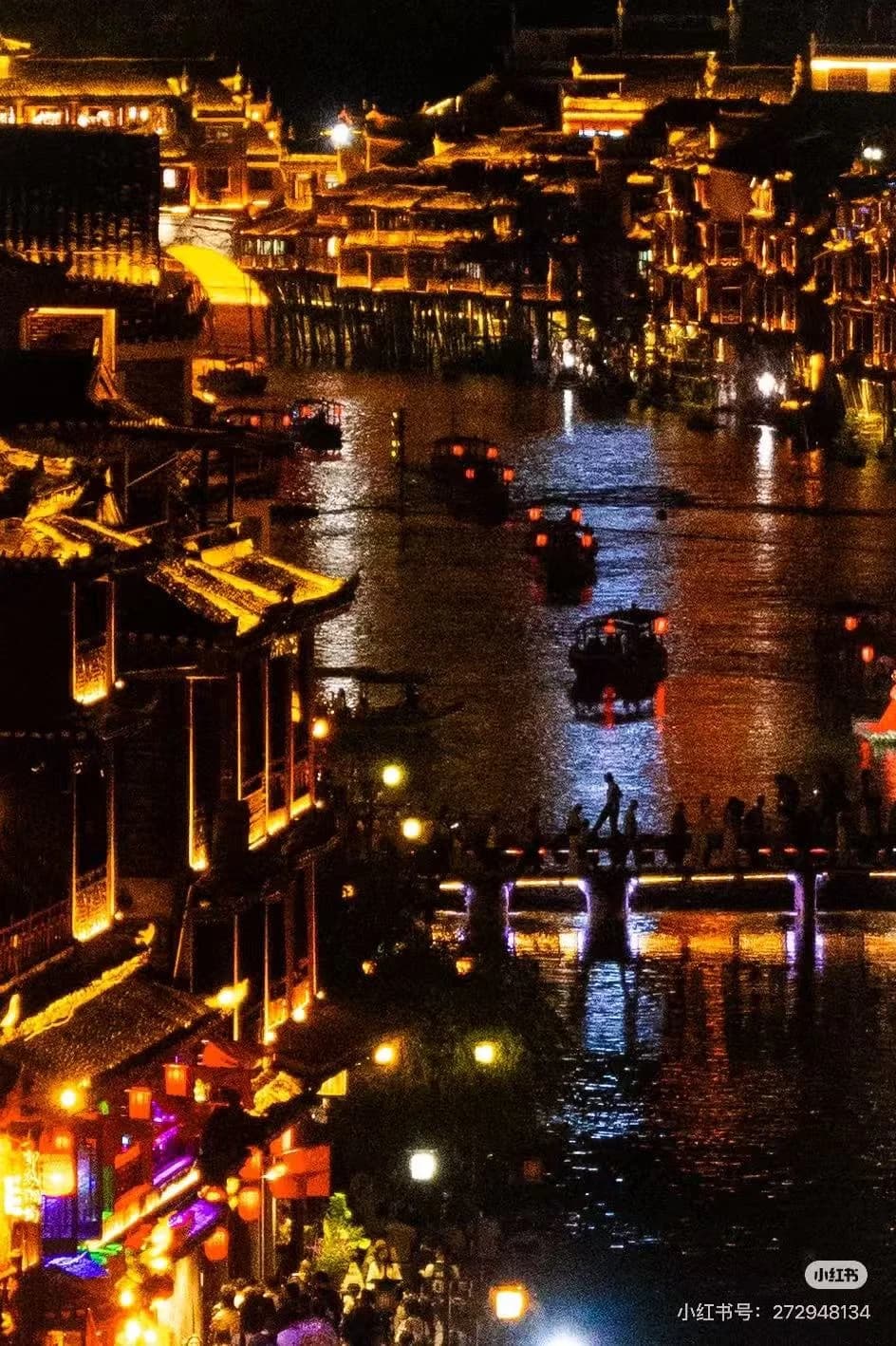
Zhangjiajie and Fenghuang sit about 1.5 hours apart by high-speed rail and could not be more different from each other. Zhangjiajie is a geology problem — quartzite sandstone columns rising hundreds of meters straight out of the forest floor, the kind of landscape that does not have a reference point anywhere else. Fenghuang is a Miao minority town on the Tuojiang River (沱江), where the wooden stilted buildings along the banks reflect in the water after dark in a way that takes a few seconds to fully register. Five days is the right amount of time: three for Zhangjiajie, with the National Forest Park, Grand Canyon Glass Bridge, and Tianmen Mountain each getting the space they need; one and a half for Fenghuang, arriving on Day 4 night and leaving Day 5 afternoon. The Tuojiang at night is the reason to time the arrival that way — the lanterns on the covered bridge and the stilted houses coming on in the dark is not something to miss by arriving in daylight.
This route works standalone or as an add-on segment to a longer China trip. It connects logically after Beijing, Shanghai, or Chengdu with a short domestic flight in.
Is This Right For You
- ✅ Good fit for travelers who have covered the main Chinese cities and want a natural landscape that reads completely differently from anything urban. The five-day format works as a standalone trip or inserted between two larger stops.
- ✅ Works well for people who are comfortable with heights. The glass bridge, Tianmen Mountain glass walkway, and Bailong Elevator all involve significant vertical exposure — these are not incidental features but the main event. If that kind of experience has appeal, the density here is right.
- ❌ Not recommended for travelers with significant acrophobia. The glass bridge and Tianmen glass walkway are deliberately designed to maximize the height sensation. Both can technically be skipped, but they account for much of why people come. Zhangjiajie on its own (without the glass elements) is still worth three days — that is a valid alternative.
- ❌ Not a fit for travelers who need strong English-language support throughout. Zhangjiajie's national park and Fenghuang's old town are both third-tier city environments. English signage exists at the main sites, but staff at restaurants, local transport, and market stalls will not speak English. A phone translation app with camera mode is essential, not optional.
Route Overview
| Days | Location | Daily Focus | Getting There |
|---|---|---|---|
| Day 1 | Zhangjiajie | Arrive, settle in Wulingyuan, optional Huangshi Fortress evening | Domestic flight |
| Day 2 | Zhangjiajie | National Forest Park full day — Yuanjiajie + Bailong Elevator | Park shuttle bus |
| Day 3 | Zhangjiajie | Grand Canyon Glass Bridge — dedicated full day, no rushing | Didi round-trip |
| Day 4 | Zhangjiajie → Fenghuang | Tianmen Mountain full day → evening train from city station | Train + taxi |
| Day 5 | Fenghuang | Full day in old town, afternoon departure | — |
Why this day split?
The National Forest Park covers 430 square kilometers — three days only reaches the core. Day 2 gives Yuanjiajie (the Hallelujah Mountain area that most people recognize from the Avatar film) and the Bailong Elevator the full day they need. Day 3 isolates the Grand Canyon Glass Bridge entirely: it is 40 kilometers from the Wulingyuan base in a different direction, and the round-trip drive alone takes nearly two hours. Compressing it into half a day leaves the canyon walk unfinished; a dedicated day means the bridge, the gorge trail, and a relaxed return to Wulingyuan for the last night there.
Day 4 puts Tianmen Mountain last because of one logistical fact: the Tianmen cable car's lower station is in Zhangjiajie city center, five minutes from the high-speed rail station. After checking out of the Wulingyuan hotel that morning, luggage goes to the train station storage, Tianmen Mountain fills the day, and the train to Jishou departs directly from the city — no backtracking to Wulingyuan. The arrival in Fenghuang at around 8–9 p.m. is intentional: the Tuojiang River at night is what makes Fenghuang worth the detour.
Best time to go: April–June (comfortable temperatures, mist works well with the landscape) and September–October (autumn light, less humidity). July–August in Hunan is genuinely hot and humid. Avoid the National Day Golden Week (October 1–7) — queues at every Zhangjiajie site multiply significantly, and the Glass Bridge quota fills well in advance.
Estimated budget (excluding long-haul flights in and out): CNY 8,000–14,000 for two people across five days, including accommodation, park tickets, meals, and city-to-city transport. The major ticket costs are Zhangjiajie National Forest Park comprehensive ticket (CNY 248), Tianmen Mountain (CNY 258), and the Glass Bridge (CNY 138).
Difficulty: Moderate. Large daily walking distances in the park; the 999 steps at Tianmen Cave require some fitness; Fenghuang is easy walking. Not suitable for mobility-impaired travelers at the park or Tianmen.
Day 1: Arrive Zhangjiajie, Settle in Wulingyuan
Afternoon: Getting in
Zhangjiajie Hehua Airport is the most practical entry point — direct flights from Beijing, Shanghai, Chengdu, and most major Chinese cities. The airport sits about 40 kilometers from Wulingyuan district where the park entrance is. A Didi ride to a Wulingyuan hotel takes about 50–60 minutes and costs CNY 60–90. The airport shuttle bus exists but runs infrequently — Didi is the reliable option.
Stay in Wulingyuan district, not the city center. Zhangjiajie city (张家界市区) is another 40 kilometers from the park gates — staying there means commuting both ways every day. Wulingyuan has hotels at every price point, all bookable through Booking.com or Trip.com without needing Chinese.
Evening: Huangshi Fortress (optional)
Huangshi Fortress (黄石寨) is the closest viewpoint to the Wulingyuan park entrance — cable car up costs about CNY 72 per person, or 40 minutes of stairs. If energy allows after the travel day, the late afternoon light on the sandstone columns is worth the trip. If not, skip it — Day 2 covers more.
Dinner: Wulingyuan street level
Tujia minority restaurants cluster around the park's main entrance. Local dishes worth trying: xiangxi sour pork (酸肉), wild vegetable stir-fries, and corn grits porridge. Budget CNY 50–100 per person for a sit-down meal. Most local restaurants take Alipay and WeChat Pay; cash is safer for smaller stalls.
Day 2: Zhangjiajie National Forest Park — Yuanjiajie and Bailong Elevator
Full day: National Forest Park
Tickets: The comprehensive park ticket costs CNY 248 per adult and is valid for four days. Foreign visitors buy with a passport at the main entrance ticket windows — an English-language counter is available. The ticket covers all park shuttle buses and the Bailong Elevator. Buy on Day 2 and the same ticket is valid again on Day 3 if needed.
Recommended route:
Morning: Yuanjiajie (哈利路亚山 area)
Take the park shuttle from Wulingyuan entrance to Yuanjiajie — about 30 minutes. This is the area that appeared in Avatar footage and where the most recognizable pillar formations are concentrated. The main viewpoint for the Hallelujah Mountain pillar (officially called Qiankun Column, 乾坤柱) is a 10-minute walk from the shuttle drop-off. From the cliff-edge walkways, the columns appear at eye level and below — the spatial effect is disorienting in a specific way that photographs do not quite capture. Walk the main Yuanjiajie loop: about 2–2.5 hours at a comfortable pace.
Afternoon: Bailong Elevator (百龙天梯)
From Yuanjiajie, either walk 15 minutes or take the shuttle to the Bailong Elevator entrance. The elevator climbs 326 meters in about 90 seconds along the exterior face of a sandstone cliff — the cabin is glass-sided, and the drop below is fully visible throughout. It is the world's highest outdoor elevator by exposed height. Queue time typically runs 20–40 minutes; going in the early afternoon beats the morning rush slightly. The elevator deposits visitors at the valley floor, where park shuttles return to Wulingyuan.
Weather note: Afternoon cloud and mist are common in Zhangjiajie — the columns in low cloud look different from the columns in clear light, and both have something to recommend them. Full rain with visibility below 50 meters closes some walkways; the park ticket's four-day validity allows a return visit if Day 2 is lost to weather.
Day 3: Grand Canyon Glass Bridge — Full Dedicated Day
Full day: Zhangjiajie Grand Canyon Glass Bridge (张家界大峡谷玻璃桥)
Why a full day: The Grand Canyon Glass Bridge is 40 kilometers from Wulingyuan in a different direction — not a minor detour. The round-trip drive is nearly two hours. Treating it as a half-day excursion means arriving rushed and leaving before the gorge trail is finished. A full day means the bridge, the full canyon walk, and a relaxed return to Wulingyuan for the last night there.
Book ahead — this is not optional: The bridge operates on a daily visitor quota. Tickets must be purchased in advance through the official mini-program (requires passport number) or through Klook and Trip.com's English platforms (simpler for foreign visitors). Price: approximately CNY 138 per adult. In peak season, book 3–7 days ahead; in low season, same-day availability is possible but not guaranteed.
Leave Wulingyuan by Didi at 8 a.m. (about CNY 80–100 one-way). Aim to arrive at the bridge by 9 a.m. to beat the midday crowd.
The bridge spans 430 meters between two cliff faces, with the canyon floor approximately 300 meters below the glass deck. Crossing and returning takes 30–40 minutes; the sensation of looking straight down through the transparent surface is different from the Tianmen glass walkway — it is a single crossing rather than an extended walk, which most people find easier to manage psychologically even if the height exposure is greater visually.
After the bridge, the canyon gorge trail is included in the ticket price and runs about 2 hours end-to-end — cliffs, stream crossings, and sections of boardwalk cut into the rock face. Worth doing in full.
Back in Wulingyuan by 4–5 p.m. Tonight is the last night in Wulingyuan — pack bags before dinner. Tomorrow morning the Wulingyuan hotel checks out and luggage goes to the city.
Day 4: Tianmen Mountain → Evening Train to Fenghuang
Morning: Check out, bring luggage to the city
Check out of the Wulingyuan hotel and take a Didi to Zhangjiajie city center — about 40 minutes (CNY 60–80). Luggage goes to the train station left-luggage counter at Zhangjiajie West Station (CNY 15–20 per bag per day), leaving hands free for the mountain.
Full day: Tianmen Mountain (天门山)
Tianmen Mountain is a separate attraction from the National Forest Park with its own ticket (approximately CNY 258 per adult, including cable car both directions). The lower cable car station is in the city center, walkable from the main commercial area.
The cable car runs 7.5 kilometers from the city to the summit — one of the longest high-altitude gondola lines in the world. The cabin is glass-sided; the ascent takes about 30 minutes and passes through cloud cover on most days.
Tianmen Cave (天门洞) is a natural arch in the cliff face at 1,264 meters elevation — 131.5 meters high, open sky visible through from the other side. From the viewing platform directly in front, the scale is hard to process: vertical rock on both sides, nothing but sky through the opening. The 999-step staircase from the cave floor to the top takes 45–60 minutes up and less down. Worth doing for anyone with reasonable fitness; the steps are steep but the path is well-maintained.
Tianmen Mountain Glass Walkway runs along the cliff edge at the summit, with a transparent glass surface underfoot and several hundred meters of exposed drop below. The experience is more sustained than the Glass Bridge — a continuous walkway rather than a single crossing — which most people find more difficult psychologically. For those who handled the Glass Bridge comfortably, this is the logical next step.
Highway 99 (通天大道) is the descent route: a park bus navigates 99 switchback turns down the mountain face. It is the road that appears in extreme driving videos, and riding it as a passenger is its own experience. Some people get motion sick; avoid heavy meals before boarding. Finish the descent by 4–4:30 p.m.
English support: Cable car station signage is bilingual. The summit has partial English signage. Translation app handles the rest.
Evening: Train to Jishou, then Fenghuang
Walk or take a two-minute Didi from the cable car lower station to Zhangjiajie West high-speed rail station. Collect luggage from left-luggage storage. Board a G- or D-train to Jishou (吉首) — journey time approximately 1.5 hours (CNY 50–80 second class; book ahead on Trip.com English platform). From Jishou station, Didi to Fenghuang Ancient Town takes about 40 minutes (CNY 60–80).
Arrival in Fenghuang: approximately 8–9 p.m.
Check in, then go directly to the Tuojiang riverbank. The stilted houses along the south bank light up after dark — the red lanterns on the Hongqiao covered bridge, the wooden structures reflected in the water below, the sound of boats moving through — this is the version of Fenghuang that most people come for and do not get if they arrive in the afternoon. Standing on the north bank looking across at 9 p.m. on Day 4 is the right way to first see it.
Book a hotel on the Tuojiang riverside if possible. The view from a riverside room in the morning is worth the slight premium.
Day 5: Fenghuang Ancient Town — Full Day, Afternoon Departure
Early morning: Old town before the crowds
Fenghuang's old town is pedestrian-scale and covers a walkable area of about 1.5 square kilometers. By 8 a.m., the streets are quiet enough to walk the main lanes without the midday crowd. The south bank's Huidilong Alley (回龙阁), a row of wooden stilted buildings clinging to the riverbank, is worth walking in the early morning light — the structure seen from the north bank across the water looks like a film set.
Entry to the town itself is free. Fenghuang discontinued its bundled gate ticket for the old town in 2019. The main walking areas, riverbank, and lanes are open without charge. Individual historical buildings — Shen Congwen's Former Residence (沈从文故居), the Yang Family Ancestral Hall — have separate tickets (CNY 15–30 each) for those interested.
Morning: Hongqiao Bridge + river boat
Hongqiao Bridge (虹桥) spans the Tuojiang and has stalls selling Miao silverwork and local crafts along both sides. The bridge is the most photographed structure in Fenghuang and easiest to access from any of the riverside hotels.
River boats (乌篷船 or bamboo raft) operate from the south bank — CNY 60–100 per person, negotiate before boarding and confirm whether the price is per person or per boat. A 20–30 minute drift past the stilted houses from water level gives a perspective the riverbank does not. The boat operators do not speak English; showing the destination on a map or holding up fingers for number of people is enough.
Late morning to afternoon: Old town lanes + Miao silver
Zhongshan Road and the riverside lane are the main commercial streets. Miao silverwork is the specific thing to look for in Fenghuang — handcrafted jewelry and headpieces made by silversmiths from families that have worked the same techniques for generations. Price is calculated by silver weight; 925 or 990 purity silver runs approximately CNY 5–8 per gram at legitimate shops. Ask the seller to weigh the piece on a scale before agreeing — any reputable shop will do this without hesitation.
Local food worth trying:
- Rice tofu (米豆腐): a cold Miao snack, served with chili and garlic paste, CNY 5–8
- Sour fish soup (酸汤鱼): tart and spicy broth with river fish, CNY 40–60 per person
- Ginger candy (姜糖): a Fenghuang specialty sold by weight at several old-brand shops on the main street
Afternoon: Departure
Fenghuang has no high-speed rail station. Options out:
- Didi to Jishou station (40 minutes, CNY 60–80) → high-speed rail to Changsha, Shanghai, Zhangjiajie, or other cities
- Private car to Changsha Huanghua International Airport (approximately 3.5 hours, CNY 350–450) — Changsha has far more flight options than Zhangjiajie and works better as a departure hub for connecting onward
Getting There and Getting Around
Getting to Zhangjiajie:
| From | Best Option | Journey Time | Notes |
|---|---|---|---|
| Beijing / Shanghai | Direct flight to Zhangjiajie Hehua Airport | 2–2.5 hours | Multiple daily flights |
| Changsha | High-speed rail to Zhangjiajie West | ~2 hours | Changsha is a better international hub |
| Chengdu / Chongqing | Direct flight or via Changsha | 2–3 hours | Direct flights are limited; Changsha connection is reliable |
Within Zhangjiajie:
Park shuttle buses (included in the CNY 248 comprehensive ticket) connect all major Wulingyuan-area sites. Didi handles everything outside the park boundary — Grand Canyon Glass Bridge, city center, airport. Set up Didi before arrival; the app has an English interface and accepts international cards via Alipay.
Zhangjiajie → Fenghuang:
Zhangjiajie West Station → Jishou: G/D-train, approximately 1.5 hours (CNY 50–80). Jishou → Fenghuang: Didi, approximately 40 minutes (CNY 60–80). Book the train ticket 3–7 days ahead on Trip.com English platform.
Within Fenghuang:
The entire old town is walkable. No transport needed inside the core area.
Practical Information
| Item | Details |
|---|---|
| National Forest Park ticket | CNY 248/adult, valid 4 days, covers park buses + Bailong Elevator. Passport purchase at main gate |
| Tianmen Mountain ticket | ~CNY 258/adult, includes cable car both ways. Separate from park ticket |
| Grand Canyon Glass Bridge | ~CNY 138/adult. Advance reservation required (passport number). Book via Klook, Trip.com, or official mini-program |
| Fenghuang town entry | Free. Individual historical buildings: CNY 15–30 each |
| Payment | Alipay and WeChat Pay work at all three main sites. Bring CNY 300–500 cash for Fenghuang market stalls and boat operators |
| Language | Zhangjiajie park has bilingual signage; Tianmen partial English; Fenghuang old town is primarily Chinese. Camera-translate on a phone handles everything else |
| Connectivity | Buy a local SIM at the airport (CNY 100–200 for a monthly data plan). Signal is weak in parts of the National Forest Park — download offline maps before entering |
| Best months | April–June, September–October |
| Budget (2 people) | CNY 8,000–14,000 including accommodation, tickets, meals, and city-to-city transport |
For payment setup before arrival, see How to Pay in China.
Book These in Advance
- □ Grand Canyon Glass Bridge ticket — Quota-limited; no on-site sales. Book via Klook or Trip.com English with passport number. In peak season, 3–7 days ahead is the minimum; do not leave this until the day before
- □ Zhangjiajie West → Jishou train ticket — Buy 3–7 days ahead on Trip.com; Golden Week dates sell out fast
- □ Fenghuang riverside hotel — Tuojiang riverfront rooms fill up on weekends and holiday weeks; book 1–2 weeks ahead
- □ Didi app — Download, register, link payment before arriving. The pickup point at Zhangjiajie airport is not complicated but you will want the app ready immediately on landing
Tips and Tricks
- Tianmen Mountain descent route: take the bus, not the cable car back down. Highway 99's 99 switchbacks are the reason the road is known internationally. Taking the bus down and the cable car up (or the reverse) means experiencing both. Taking the cable car both ways misses the road entirely.
- Glass Bridge versus Tianmen glass walkway — what to expect: The Glass Bridge is a single crossing, roughly 30 minutes, with the canyon floor visible 300 meters below. Most people find it dramatic but manageable. The Tianmen glass walkway is a continuous path along the cliff edge — the exposure lasts longer and psychologically is harder for most people. Both are worth doing if heights are not a problem; if they are, the Glass Bridge is the easier one to attempt first.
- Wulingyuan comprehensive ticket: use the four-day validity. The CNY 248 ticket is valid across four days. Day 2 covers Yuanjiajie and the Bailong Elevator. If the Grand Canyon Glass Bridge visit on Day 3 finishes early, the ticket allows re-entry to the forest park on the same day.
- Fenghuang silver: weigh before you buy. Ask the seller to weigh the piece on a scale and state the silver purity before agreeing on a price. Any established shop will do this without objection. Pieces sold by appearance only rather than by weight are a flag worth noting.
- Arrive at the Glass Bridge by 9 a.m. The midday crowd at the bridge is substantially larger than the morning one. The gorge trail after the bridge also gets progressively busier — finishing the trail by 1 p.m. puts the return Didi into lighter traffic.
- Fenghuang night versus morning: The riverbank at night (Day 4 arrival) and the old town lanes early morning (Day 5, before 9 a.m.) are two genuinely different versions of the same place. The night version has the lanterns and reflections; the morning version has quiet streets and better light for photography. Both are worth prioritizing.
- Cash in Fenghuang: Keep CNY 300–500 on hand. Boat operators, most food stalls, and some craft vendors operate on cash or WeChat Pay only — the type of small-scale transactions where a card or foreign app may not work.
What to Cut If You're Short on Time
3-day version (Zhangjiajie only, skip Fenghuang):
- Day 1: Arrive, evening in Wulingyuan
- Day 2: National Forest Park (Yuanjiajie + Bailong Elevator)
- Day 3: Either Tianmen Mountain or Grand Canyon Glass Bridge — pick one. Tianmen has more variety (cave, walkway, road); Glass Bridge is the single most distinctive experience. If only one, the Glass Bridge slightly edges it for first-time visitors, but Tianmen Mountain is the more complete day
4-day version (compressed Fenghuang):
- Keep Zhangjiajie Days 1–3 intact (Forest Park + Glass Bridge + Tianmen)
- Day 4: Tianmen Mountain morning → afternoon train to Jishou → evening arrival Fenghuang
- Skip the dedicated Day 5 in Fenghuang; spend Day 4 night on the riverbank, morning walk before departure. Half a day in Fenghuang still catches the essential image
Do not cut:
- Yuanjiajie (the Hallelujah Mountain area). This is the reason Zhangjiajie is on the itinerary; removing it leaves no specific reason to come over other mountain parks in China
- Bailong Elevator. There is no equivalent experience elsewhere
- Day 4 evening arrival in Fenghuang. The night riverbank view is what makes the detour worth it — arriving in daylight and leaving the same day converts Fenghuang into a generic old town visit
Before You Go Checklist
- □ Confirm visa status — Check current entry requirements for your nationality. See Visiting China Visa-Free for the current exemption list
- □ Alipay International — Link an international Visa or Mastercard at least 2 weeks before departure. Test a transaction before the trip
- □ Grand Canyon Glass Bridge ticket — Book with passport number via Klook or Trip.com. Confirm the date before other bookings around it
- □ Zhangjiajie West → Jishou train — Buy on Trip.com; have the booking confirmation downloaded offline in case of poor signal
- □ Didi app — Download, register, link payment before landing
- □ Offline maps — Download Baidu Maps or Amap offline packs for Zhangjiajie and Fenghuang. Signal in the National Forest Park is unreliable
- □ Cash — Withdraw CNY 500–800 before entering Fenghuang. The town's market stalls and boat operators run on cash and local apps, not international cards
FAQ
Is the National Forest Park really that large? Can it all be done in one day?
No. At 430 square kilometers with sites spread across multiple ridge systems, one day covers one zone. Day 2 gives Yuanjiajie and the Bailong Elevator — that is a complete and satisfying day. The Tianzi Mountain area and Yangjiajie section exist within the same comprehensive ticket if the trip is extended, but they are not reached on a five-day itinerary and are not missed.
Glass Bridge versus Tianmen Mountain glass walkway — which is more intense?
The Glass Bridge is a single 430-meter crossing above a 300-meter drop — visually dramatic but finite. The Tianmen walkway is a sustained path along the cliff edge where the exposure continues for the full duration of the walk. Most people find the walkway harder psychologically, even though the Glass Bridge drop is visually more extreme. Both can be done on this itinerary; if one has to be chosen, the Glass Bridge is the more iconic single moment, while Tianmen Mountain has more to offer overall beyond the glass section.
Does Fenghuang still charge a gate ticket for the old town?
The bundled old-town ticket was discontinued in 2019. The town's lanes, riverbank, and bridges are free to walk. Individual heritage buildings (Shen Congwen's former residence, ancestral halls) have separate admission fees of CNY 15–30. Verify this before travel — the policy has changed once and could change again.
What is the best way to leave Fenghuang?
Didi to Jishou high-speed rail station (40 minutes, CNY 60–80) is the most flexible option, connecting to Changsha, Shanghai, or back toward Zhangjiajie. If the next stop is a flight, driving directly to Changsha Huanghua International Airport (about 3.5 hours, CNY 380–450) avoids one transfer and gives access to a much wider range of departure routes than Zhangjiajie Airport.
How does this trip connect to other China itineraries?
Zhangjiajie connects by direct flight from Beijing, Shanghai, Chengdu, Chongqing, and Guangzhou. It works as a five-day segment inserted between two larger stops — fly in from one city, fly out (or train out via Changsha) to another. For a broader Hunan angle, Changsha itself has a half-day's worth of interest (the Hunan Provincial Museum has one of the best-preserved Han dynasty burial sites in China) and sits on the main Beijing–Guangzhou high-speed rail line.
Five days in Zhangjiajie and Fenghuang covers more ground than the day count suggests — the landscapes are specific enough that each site registers distinctly rather than blurring together. The Bailong Elevator going up the cliff face and the Tuojiang River after dark are the two images that tend to stay with people. Neither requires much planning to reach: the elevator is a 30-second ride built into the park ticket, and the river is a five-minute walk from any hotel on the south bank. Getting there is the harder part. Once there, the logistics are straightforward.
Related guides: Zhangjiajie City Guide | Zhangjiajie National Forest Park | Tianmen Mountain | Grand Canyon Glass Bridge | Visiting China Visa-Free