Last updated: May 2026. Prices vary by city and shop—verify on site.
There are more Lanzhou beef noodle shops in China than there are McDonald's locations. This explains why the dish appears in virtually every Chinese city—and also why the quality range is wide enough that "Lanzhou noodles" could describe a ¥10 bowl of handmade excellence or a ¥28 bowl of machine-pressed mediocrity in a mall food court. The two things share a name and not much else.
What's in the Bowl
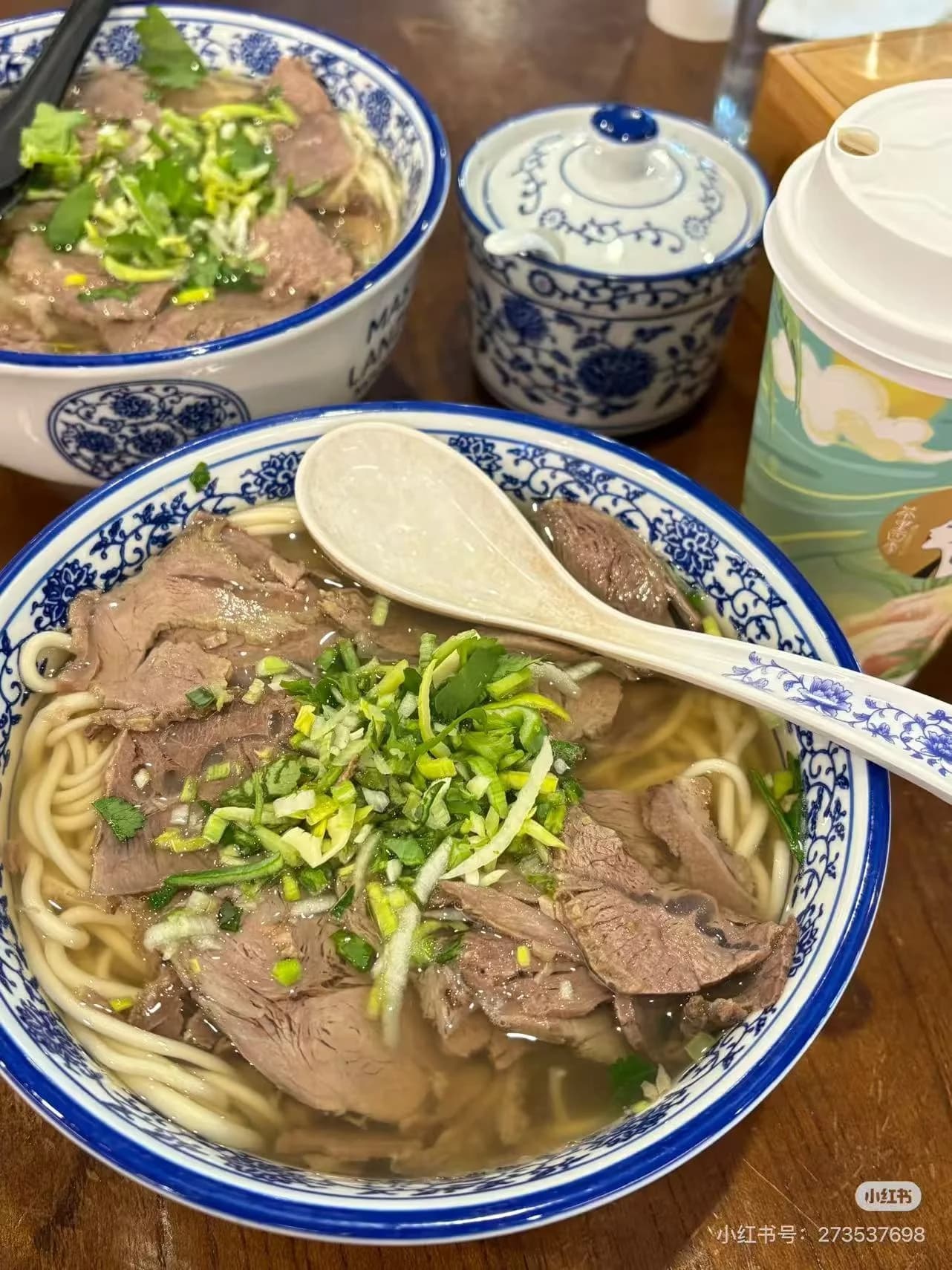
Lanzhou beef noodles—called lanzhou niurou mian (兰州牛肉面) in full, or just niurou mian at the counter—follow a formula that locals describe in five parts: clear broth, white radish, red chili oil, green herbs, yellow noodles. The broth is simmered from beef bones and runs completely clear, not cloudy. On top: a few slices of braised beef, rounds of white radish, a ladle of red chili oil, and a scattering of fresh cilantro and garlic shoots. The noodles are hand-pulled fresh to order.
This is not a heavy dish. There's no sauce, no thick base, nothing built to overwhelm. It's a bowl that relies on the broth and the texture of the noodles, which is why the difference between a good version and a mediocre one shows up immediately.
One thing worth knowing: Lanzhou beef noodle shops are traditionally run by Hui Muslim families and serve only beef—no pork. The dish is halal. This makes it one of the more accessible noodle options for Muslim travelers in China.
The Noodle Width: The Only Real Decision at the Counter
When you reach the front of the queue, the chef will ask what shape noodles you want. This is the main choice, and most first-timers aren't ready for it.
| Name | Shape | Texture |
|---|---|---|
| Maoci (毛细) | Extremely thin, almost like vermicelli | Soft, soaks up broth quickly |
| Xi (细) | Thin round noodle | The standard; chewy, holds its shape |
| Erxi (二细) | Slightly thicker round | More bite, slightly more filling |
| Jiuye (韭叶) | Flat, width of a chive leaf | Medium width, slightly softer |
| Kuan (宽) | Wide flat noodle | Thick and substantial |
| Dakuan (大宽) | Widest, close to hand-torn | Maximum chew, best for slower eating |
If you don't have a preference: say xi (细). It's the most common choice and works with the broth without overpowering it.
Finding the Real Version
The sign outside matters. "兰州牛肉拉面" or "兰州牛肉面" is the full name. Shops that just say "兰州拉面" are often serving a different, lower-quality product with machine-made noodles and pre-made broth concentrate.
The clearest signal that a shop is doing it properly: a chef pulling noodles in full view of the counter. Hand-pulling takes skill and happens in front of customers—if you can't see anyone pulling, the noodles are probably machine-made.
Other signs of a real shop:
- Male staff often wearing white skullcaps (traditional for Hui Muslim workers)
- Price between ¥10–18 per bowl
- Opens early (around 6–7am), closes by early afternoon when the broth sells out
- Queue at peak breakfast hours
Mall chains and food court versions are not automatically bad—they're consistent and easier to navigate without Chinese—but they sit at a different level. The ¥10 bowl from a small shop with a hand-pulling chef will usually outperform the ¥25 mall version on broth depth and noodle texture.
In Lanzhou itself: any shop, no research needed. The city runs on this dish and the baseline quality is high across the board.
Practical Notes for International Visitors
Ordering: Walk up to the window, say the noodle width you want (or point at the characters on the board), and wait. Some shops require payment upfront; others collect at the end. Watch the person ahead of you. There's no menu beyond the noodle shape—the bowl comes with everything already included.
Condiments: The table will have chili oil, vinegar, and sometimes salt. All optional. Adding a small amount of vinegar to the broth is common and changes the flavor noticeably.
Spice: The ladle of chili oil on top is standard. If you prefer less, say "shao la" (少辣, less spicy) or "bu yao la jiao" (不要辣椒, no chili) at the window. Most shops accommodate this.
Payment:
| Method | Notes |
|---|---|
| ✅ WeChat Pay / Alipay | QR code usually posted at the counter; set up before arrival—How to Pay in China |
| ✅ Cash (RMB) | Always accepted; ¥20 is enough for one bowl |
| ⚠️ International cards | Not applicable at street-level shops |
Language: Minimal Chinese needed. Point at the noodle width on the board, hold up one finger for one bowl. If you need to communicate dietary restrictions, prepare the relevant text on your phone in advance—How to Order Food in China has ready-made cards.
Timing: Go before 11am. The broth is freshest in the morning, and many good small shops sell out by early afternoon. This is not a dinner dish at most authentic shops.
Cost reference:
| Item | Price |
|---|---|
| Standard bowl (any noodle width) | ¥10–18 |
| Extra beef | ¥5–10 |
| Tea or soft drink (where available) | ¥3–8 |
Common Mistakes
Mistake 1: Ordering from a mall chain and concluding the dish isn't worth it — Mall versions are usable but not representative. Find a shop with a hand-pulling chef before deciding what you think of Lanzhou noodles.
Mistake 2: Not knowing the noodle width system — The chef's question about noodle shape catches most first-timers off guard. Decide before you reach the counter; "xi" (细) covers you if you're unsure.
Mistake 3: Going after 1pm — Many good shops close when the broth runs out. Lanzhou beef noodles are a morning meal at proper shops.
Mistake 4: Skipping the vinegar — The small bottle on the table is worth trying. A small amount brightens the broth in a way that's different from the chili oil and rounds out the bowl.
Mistake 5: Assuming it contains pork — It doesn't. Halal beef only. This is one of the easier dishes for Muslim travelers to navigate in China.
Lanzhou beef noodles are available on almost every block in China's cities, and a good bowl costs less than a coffee. The main work is in finding the version with hand-pulled noodles and properly made broth—the visual of a chef stretching dough at the counter is the most reliable signal. Choose xi (细) if uncertain, add a small amount of vinegar, and go before noon. For where this bowl fits in the wider picture of Chinese regional food, see the Chinese Food Regional Guide.